Apartments Near South Coast Plaza: What Renters Should Know
A measured look at the South Coast Plaza and Segerstrom arts district pocket of Costa Mesa, from 3400 Avenue of the Arts. Every walk and drive time was routed on OpenStreetMap on 5 October 2026, including the correction that the Orange County Museum of Art is a six-minute walk, not two.
If you are searching for apartments near South Coast Plaza, you are searching inside an unusual piece of Orange County. The blocks around Avenue of the Arts are not a residential neighbourhood that happens to have a mall nearby. They are a cultural and retail district — a concert hall, a repertory theatre, an art museum, a very large shopping centre and a cluster of office towers — into which a small number of apartment buildings have been inserted. 3400 Avenue of the Arts sits inside that district rather than beside it, which makes it a useful vantage point for describing what the area is actually like to live in. What follows is measured rather than remembered: every walking and driving figure below was routed on 5 October 2026 using the OpenStreetMap foot and car profiles, with each destination geocoded to the nearest edge of its building footprint rather than to its centroid.
What living near South Coast Plaza actually means
The honest summary is that this is a district with exceptional cultural access, genuinely poor everyday convenience, and a car dependency that the walkability of the arts campus disguises. You can be at an art museum in six minutes on foot and at a world-class concert hall in six. You cannot buy a carton of milk in under twenty minutes on foot in any direction. Both of those statements are true at once, and renters who only hear the first one tend to be surprised by the second in their first week.
The arts campus is real and it is close. What is missing is the layer underneath it — the corner shop, the small grocer, the neighbourhood pub, the things that make a district feel inhabited rather than visited. South Coast Metro was planned around destinations people drive to, and the pedestrian infrastructure reflects that: wide arterial roads, long blocks, large surface and structure parking, and relatively few at-grade crossings. The walking that works here is walking within the arts campus. Walking out of it is a different experience.
Where this pocket starts and stops
The pocket worth defining is small. Anchored on the 3400 Avenue of the Arts address in Costa Mesa, it runs roughly from the Segerstrom arts campus on the west side of Avenue of the Arts, north and west toward the South Coast Plaza property, and south toward Sunflower Avenue. Within about eight minutes on foot you reach the museum, the concert hall, the repertory theatre and a sculpture garden. Beyond that ring you are crossing arterial roads and entering either the Bristol Street retail corridor, which is partly in the city of Santa Ana, or the office blocks south of the property.
That city boundary matters more than it sounds. Several of the amenities renters assume are "in the neighbourhood" are in a different municipality across Bristol Street, which affects nothing legally for a tenant but does explain why the walk feels longer than a map suggests: Bristol is a major arterial and the pedestrian route does not cut straight across it.
The walk times, measured
Routing from the building's published coordinates on 5 October 2026, using the OpenStreetMap pedestrian profile, the arts campus genuinely is walkable. The Orange County Museum of Art is 448 metres by the pedestrian network, about six minutes. Segerstrom Center for the Arts is 454 metres, about six minutes. South Coast Repertory is 548 metres, about seven minutes. California Scenario, the Noguchi-designed sculpture garden tucked among the office towers, is 623 metres, about eight minutes. Those are four substantial cultural institutions inside a ten-minute walk, which is not something most apartment addresses in Orange County can claim.
South Coast Plaza is further than the marketing shorthand implies. The nearest edge of the mall property is 1,038 metres on foot, about fourteen minutes. That figure is to the edge of the property, not to a shop — the centre is very large, so reaching a specific store means adding walking time inside it. It is worth noting how much the measurement method matters: routing to the mall's geographic centroid instead of its nearest edge returns 1,373 metres and about eighteen minutes, a figure that would be misleading in both directions. This is also why "across the street" is the wrong phrase for the concert hall; the two sites face each other, but the pedestrian route between them is still 454 metres.
The two-minute-walk claim does not survive routing
A figure circulates for this address saying the Orange County Museum of Art is a two-minute walk. It is not, and the discrepancy is instructive rather than malicious. The straight-line distance from the building to the nearest corner of the museum is about 226 metres, which at a normal pace really would be close to a two or three minute walk if you could travel in a straight line. You cannot. The actual pedestrian route is 448 metres — roughly double — because it has to follow the path network around the intervening frontage. Six minutes is the number that reflects what your legs do.
This is the single most common way neighbourhood claims go wrong in this district: straight-line proximity is excellent, pedestrian-network proximity is merely good, and driving distance is sometimes longer still because of one-way circulation around the arts campus. The museum is 448 metres on foot but 158 metres by car over a different, shorter road link; South Coast Plaza is 1,038 metres on foot but 1,532 metres by car. Treat any single number you are quoted here with suspicion unless you know which of the three it is.
Groceries are the honest problem here
If the question is whether you can buy groceries on foot, the honest answer is effectively no. The nearest full supermarket is a Vons on Bristol Street, 1,816 metres by the pedestrian network, about twenty-four minutes each way. The nearest Trader Joe's, on South Bristol Street, is 1,975 metres, about twenty-six minutes. Mitsuwa on Paularino Avenue is 1,861 metres, about twenty-five minutes. A CVS pharmacy on Bristol Street is closer at 1,303 metres, about seventeen minutes, and the nearest convenience store, an ExtraMile forecourt shop also on Bristol, is 1,295 metres, about the same.
So a forty-eight-minute round trip on foot for a supermarket shop, carrying bags back along an arterial road, or three to four minutes in the car. In practice every resident drives, and that is the trade. There is no corner shop. There is no small grocer inside the arts campus. The food that is genuinely walkable is restaurant food, not provisions — which is a meaningful distinction if you cook, and almost no distinction at all if you do not.
A normal Tuesday evening
This is where the district's character shows most clearly. The Orange County Museum of Art, the closest cultural institution to the front door, is open Wednesday to Sunday from 11 a.m. to 6 p.m. and is closed on Mondays and Tuesdays, with free admission and no reservation required when it is open. Free entry to a serious museum six minutes from your door is a genuine perk. It is also a perk that is unavailable on a Tuesday evening, and unavailable on any evening, because the museum shuts at six.
The concert hall and the theatre operate on performance schedules, which means the district has two completely different characters depending on whether something is on. On a performance night the arts campus is busy, well lit and full of people walking. On a Tuesday with no performance, the plazas are quiet, the office towers have emptied, and what remains open within walking distance is restaurants and the mall's dining options. That is not nothing — but it is a district that switches off rather than one that hums along at a low level the way an established residential neighbourhood does.
What the district is built around
It is worth being plain about the underlying logic of the place. South Coast Metro was assembled around a shopping centre, a performing arts campus and commercial office space. Housing arrived later and in small quantities. Everything about the street layout serves the first three uses: the roads are sized for event traffic and retail peaks, parking is abundant and consolidated, and the public realm is designed as plaza space between institutions rather than as streets with shopfronts.
The consequence for a resident is that the amenities are excellent and the fabric is thin. You get cultural institutions, a very large retail offer and easy freeway access to the 405 and the 55. You do not get the incidental street life that comes from a neighbourhood built around people living in it. Whether that is a fair trade depends almost entirely on how you actually spend your weeknights.
Who this trade actually suits
It suits people whose social life is destination-based rather than neighbourhood-based: subscribers to the concert hall or the theatre, people who travel often and value being minutes from John Wayne Airport, people working in the surrounding office towers who want a short commute, and people who will drive for a weekly shop without resenting it. It suits dual-income households where the car is a given.
It suits less well anyone who wanted to swap a car for a walkable life. The walkability here is specific and cultural, not general and practical. If your mental image was stepping out for coffee and a newspaper, the reality is a seventeen-minute walk to a forecourt shop or a two-minute drive. Being honest about that in advance is the difference between a renter who loves this address and one who feels misled by it.
What to check before signing
Three things are worth verifying in person rather than on a map. First, walk the route to the mall yourself at the time of day you would actually do it, because fourteen minutes along an arterial is a different experience from fourteen minutes through a neighbourhood. Second, ask which direction your unit faces relative to the arts campus and the surrounding roads, since event nights change the noise and traffic pattern. Third, confirm what the building itself gives you that the district does not, because the on-site amenities are genuinely the counterweight here.
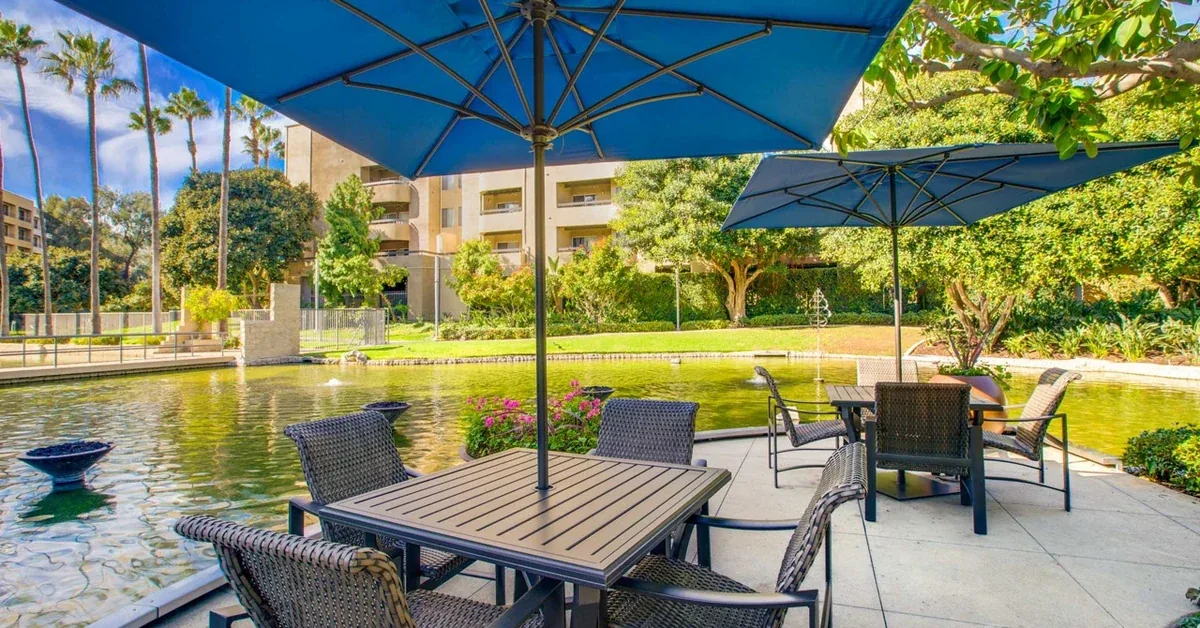
At 3400 Avenue of the Arts, the live listing on 5 October 2026 showed five floor-plan types — a 530 square foot studio, two 750 square foot one-bedrooms, an 875 square foot one-bedroom with a loft, and a 1,220 square foot two-bedroom — with twelve individual homes listed as available. Studios were listed in the mid-$2,500s, one-bedrooms from the high-$2,900s into the low-$3,200s, the loft one-bedroom in the mid-$3,600s to low-$3,700s, and two-bedrooms in the mid-$3,500s to mid-$3,600s, all as of 5 October 2026. A quirk worth noticing: the loft one-bedroom currently prices above the two-bedroom, so if you want the extra volume you pay more than you would for an extra bedroom. There is also a package locker charge billed at $75 a year, checked 10 September 2026. Confirmed on-site amenities include two saltwater pools with spas, a 15,000 square foot fitness centre with a rock-climbing wall, a yoga studio, a spin studio, a weight room, a fireplace lounge, landscaped outdoor lounges and water features, a dog park, a barbecue lounge and in-home laundry. For the full layout-by-layout comparison, see the floor plans guide; for how the loft layouts actually live, see the Costa Mesa loft apartments guide; and for the building in full, see the community guide.
Rents, availability and opening hours in this article were checked on 5 October 2026 and move frequently. Rent figures are given as bands because this community reprices units daily; confirm current pricing, availability and fees directly with the leasing office before making a decision. Walking and driving times were routed on OpenStreetMap's foot and car profiles on 5 October 2026 and reflect typical conditions, not live traffic.
Frequently asked questions
How far is South Coast Plaza from 3400 Avenue of the Arts on foot?
The nearest edge of the South Coast Plaza property is 1,038 metres by the pedestrian network, about fourteen minutes' walk, routed on OpenStreetMap's foot profile on 5 October 2026. That is to the edge of the property rather than to a specific shop, so reaching a particular store adds time inside the centre. By car the same trip routes 1,532 metres, under three minutes in typical conditions.
Can you walk to the Orange County Museum of Art from the apartments?
Yes, and it is the closest cultural institution to the building. The pedestrian route measures 448 metres, about six minutes, routed 5 October 2026. Note that figures describing this as a two-minute walk reflect straight-line distance of roughly 226 metres rather than the actual path, which has to follow the network around intervening frontage.
Is the Orange County Museum of Art free to visit?
Yes. The museum states free admission with no reservation required, and lists opening hours of 11 a.m. to 6 p.m., Wednesday to Sunday, closed Mondays and Tuesdays, per its visitor information page accessed 5 October 2026. Confirm before travelling, as hours and exhibition schedules change.
Can you buy groceries on foot near South Coast Plaza?
Not realistically. The nearest supermarket, a Vons on Bristol Street, is 1,816 metres on foot, about twenty-four minutes each way; a Trader Joe's on South Bristol Street is 1,975 metres, about twenty-six minutes; and Mitsuwa on Paularino Avenue is 1,861 metres, about twenty-five minutes. All were routed 5 October 2026. Residents drive for grocery shopping, typically a three to four minute trip.
Is Segerstrom Center for the Arts walkable from Avenue of the Arts?
Yes. The pedestrian route is 454 metres, about six minutes, routed 5 October 2026. The two sites face each other, but "across the street" overstates it slightly, since the walking route still covers most of half a kilometre. South Coast Repertory is a little further at 548 metres, about seven minutes.
What does it cost to rent an apartment near South Coast Plaza?
At 3400 Avenue of the Arts on 5 October 2026, listed base rents ran from the mid-$2,500s for a 530 square foot studio up to the low-$3,700s for an 875 square foot one-bedroom with a loft, with one-bedrooms in between from the high-$2,900s into the low-$3,200s and two-bedrooms in the mid-$3,500s to mid-$3,600s. These reprice frequently, so treat them as bands and confirm current pricing with the leasing office.
Do you need a car to live near South Coast Plaza?
For most people, yes. The cultural institutions are walkable but everyday errands are not: the nearest supermarket is a twenty-four minute walk and the nearest convenience store about seventeen. Freeway access to the 405 and the 55 is a selling point of the location, which tells you something about how the district expects residents to get around.
What floor plans are available at 3400 Avenue of the Arts?
The live listing on 5 October 2026 showed five plan types: a 530 square foot studio with one bathroom, two distinct 750 square foot one-bedrooms with one bathroom, an 875 square foot one-bedroom with a loft and one bathroom, and a 1,220 square foot two-bedroom with two bathrooms. Twelve individual homes were listed as available across those five plans. Availability changes daily.
What is there to do within walking distance on a weeknight?
Restaurants and the mall's dining options, chiefly. The museum closes at 6 p.m. and is shut Mondays and Tuesdays, and the concert hall and theatre run on performance schedules, so on a night without a performance the arts campus is quiet and the surrounding office towers are empty. The district is lively when something is on and subdued when nothing is.
Are there parks or green space within walking distance?
The nearest designed green space is California Scenario, the Noguchi sculpture garden among the office towers, 623 metres on foot or about eight minutes, routed 5 October 2026. It is a sculpture garden rather than a park, so it suits a walk or a sit rather than recreation. The building's own landscaped grounds, water features and dog park cover day-to-day outdoor use.